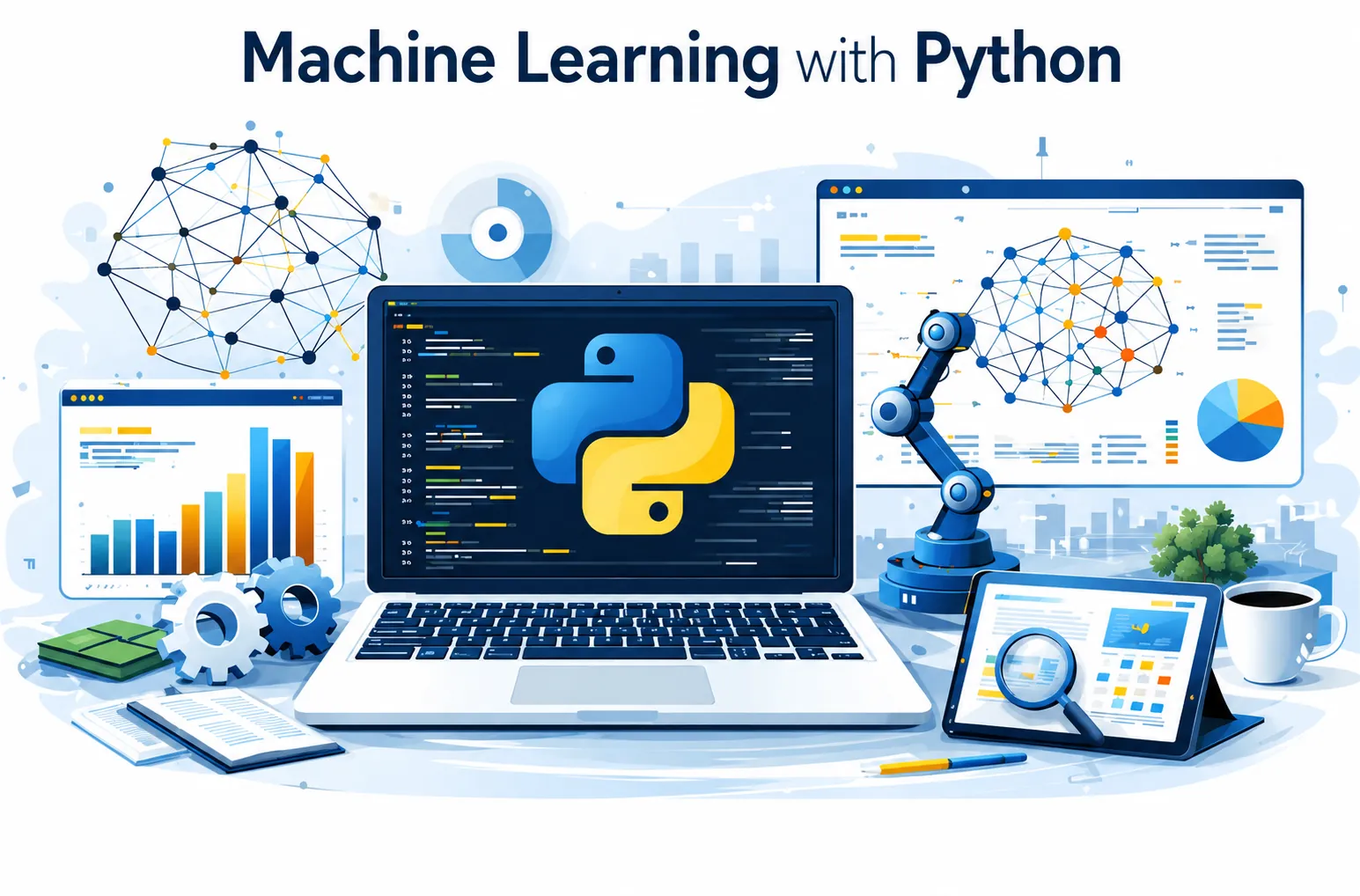
Machine Learning with Python is now one of the main entry points for anyone looking to work with Artificial Intelligence in a practical and professional way. Technology companies, fintechs, e-commerce businesses, and startups use machine learning models to automate decisions and generate value from data.
Despite the field’s rapid growth, many developers still have questions about what Machine Learning actually is, how it works in practice, and why Python has become the standard language for this ecosystem.
In this article, you’ll learn the fundamental concepts of Machine Learning, Python’s role in modern AI, the main libraries used in the field, and how to structure your learning journey from the ground up.
What Is Machine Learning?
Machine Learning is a subfield of Artificial Intelligence that enables systems to learn patterns from data without requiring manually programmed rules for every possible scenario.
Instead of writing fixed conditions, developers train a mathematical model using examples, allowing it to make predictions or classifications on new data.
Why Is Python the Leading Language for Machine Learning?
Python has become the dominant language in Machine Learning due to a combination of technical and strategic advantages:
Simple syntax and productivity: Python’s clean syntax reduces code complexity and allows developers to focus on mathematical and statistical concepts rather than low-level language details.
Mature library ecosystem: Python offers optimized, stable, and widely tested libraries for data analysis, machine learning, and deep learning, accelerating the development of AI solutions.
Community and support: Its large community provides extensive documentation, ready-to-use examples, courses, technical articles, and continuous development of its tools.
Fundamental Machine Learning Concepts
Before implementing models in Python, it is essential to understand the fundamental concepts that underpin Machine Learning.
Types of Learning
Supervised Learning
Examples include price prediction, spam detection, and image classification.
Unsupervised Learning
Examples include customer segmentation and exploratory data analysis.
Reinforcement Learning
Examples include games, robotics, and adaptive recommendation systems.
Basic Machine Learning Pipeline in Python
A Machine Learning project with Python follows a well-defined pipeline that ensures data quality, model reliability, and reproducible results. Each stage has clear objectives and specific tools from the Python ecosystem.
1. Data Collection and Cleaning
This is one of the most critical stages of Machine Learning, as model quality depends directly on data quality.
What it involves:
Collecting data from files (CSV, Excel, JSON)
Integrating with databases
Consuming APIs
Removing inconsistent or duplicate data
Handling missing values
Standardizing formats
Libraries used:
Pandas
NumPy
Common activities include:
Filling null values with the mean or median
Removing outliers
Converting data types
Poorly prepared data can result in inaccurate models, even when using advanced algorithms.
2. Exploratory Data Analysis
Exploratory data analysis helps you understand the behavior of the data before modeling.
What it involves:
Descriptive statistics
Visualizing distributions
Identifying correlations
Detecting patterns and anomalies
Libraries used:
Pandas
Matplotlib
Seaborn
Main objective:
Understand how variables relate to one another and identify which ones may have a real impact on the model.
This stage guides important decisions in the following phases.
3. Feature Selection
Features are the variables used by the model to learn patterns.
What it involves:
Selecting relevant variables
Creating new features from existing data
Normalizing and standardizing values
Encoding categorical variables
Libraries used:
Pandas
Scikit-learn
Practical examples:
Converting dates into day, month, and year
Normalizing numerical values
Converting categories into numerical values using One-Hot Encoding
Good feature engineering can significantly improve model performance.
4. Model Training
At this stage, the algorithm learns patterns from the prepared data.
What it involves:
Choosing the algorithm
Splitting data into training and testing sets
Adjusting parameters
Training the model
Libraries used:
Scikit-learn
TensorFlow
PyTorch
Common algorithms include:
Linear Regression
Decision Trees
Random Forest
Neural Networks
The goal is to find a model that generalizes well to previously unseen data.
5. Performance Evaluation
After training, the model must be evaluated objectively.
What it involves:
Measuring model accuracy
Comparing different algorithms
Identifying overfitting and underfitting
Common metrics include:
Accuracy
Precision and recall
F1-score
Mean Absolute Error (MAE)
Mean Squared Error (MSE)
This stage ensures that the model actually delivers value rather than simply producing good results on training data.
6. Deployment and Monitoring
Once validated, the model is deployed for real-world use.
What it involves:
Exporting the trained model
Integrating it with APIs or other systems
Monitoring performance over time
Retraining when necessary
Common technologies include:
REST APIs
Docker
Cloud services
MLOps
Over time, data can change, and the model must be monitored to prevent performance degradation.
This pipeline is not rigid. In real-world projects, the stages are iterative, and adjustments are continuously made based on the results obtained.
Mastering this workflow is essential for developing reliable, scalable, and production-ready Machine Learning solutions with Python.
Main Machine Learning Libraries in Python
There are numerous libraries available for working with AI. Let’s take a look at some of the most widely used examples.
NumPy
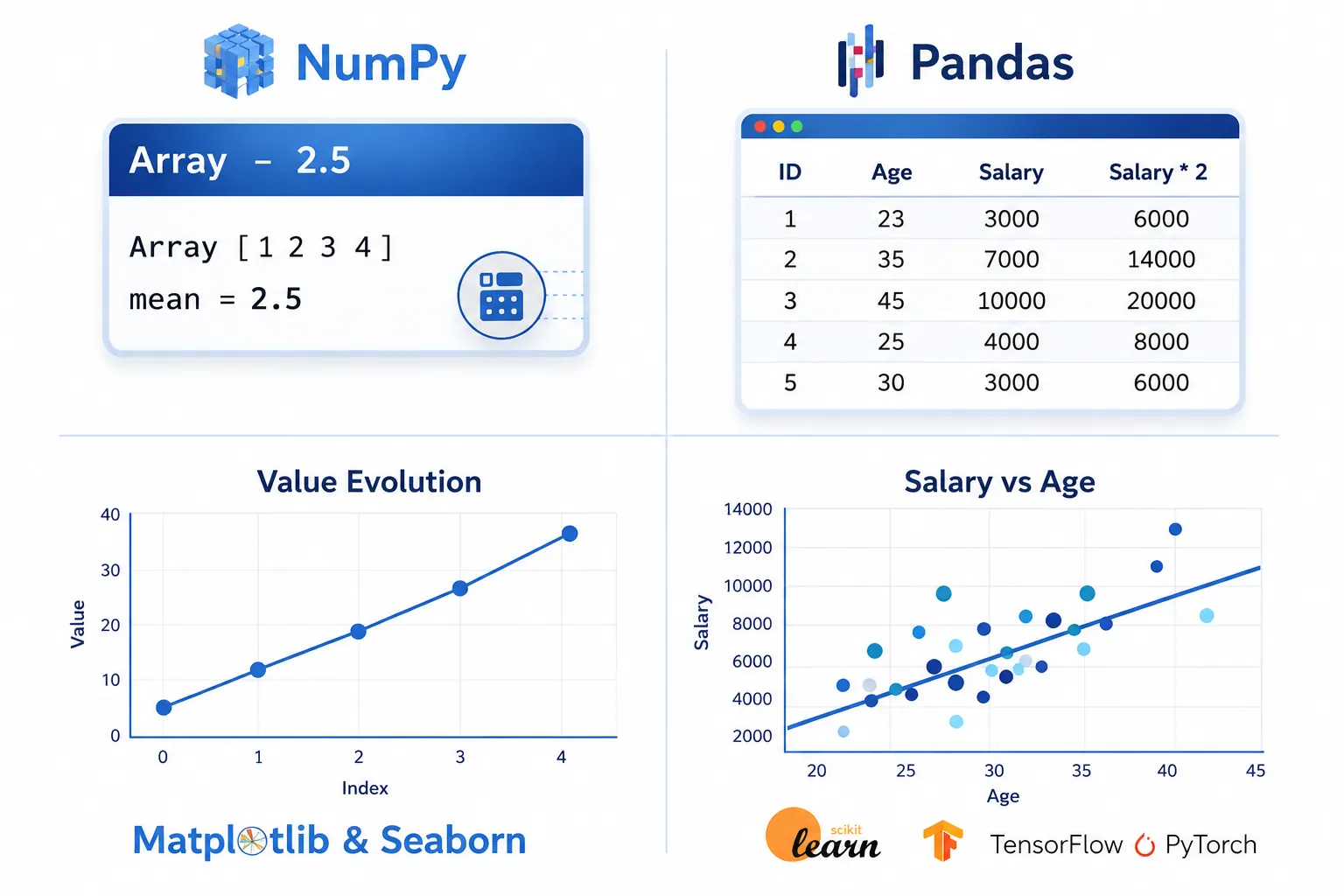
NumPy is the foundation of numerical computing in Python. It provides efficient structures for working with arrays, vectors, and matrices, along with high-performance mathematical operations used internally by libraries such as Pandas, Scikit-learn, and TensorFlow.
What does this code do?
np.array([1, 2, 3, 4])creates a NumPy array from a Python list.np.mean(array)calculates the arithmetic mean of the values.The result stored in
mediais2.5.
This type of operation is common in data preprocessing and statistical calculations used in Machine Learning.
import numpy as np
array = np.array([1, 2, 3, 4])
mean = np.mean(array)
Pandas
Pandas is used for reading, cleaning, transforming, and analyzing structured data, typically in tabular formats such as CSV files, Excel spreadsheets, and databases.
What does this code do?
pd.read_csv("data.csv")reads a CSV file and creates a DataFrame.A DataFrame is a tabular data structure consisting of rows and columns.
df.head()displays the first 5 rows of the dataset.
This step is essential before applying any Machine Learning algorithm.
import pandas as pd
df = pd.read_csv("data.csv")
print(df.head())
Scikit-learn
Scikit-learn provides ready-to-use implementations of classic Machine Learning algorithms, including regression, classification, and clustering, with a focus on simplicity and standardization.
What does this code do?
LinearRegression()creates a linear regression model.fit(X_treino, y_treino)trains the model using input data (X) and the corresponding target values (y).
The model learns the mathematical relationship between the variables so it can make future predictions.
from sklearn.linear_model import LinearRegression
modelo = LinearRegression()
modelo.fit(X_train, y_train)
Matplotlib e Seaborn
These libraries are used for data visualization, making it easier to identify patterns, outliers, and trends before or after training Machine Learning models.
Example with Matplotlib
import matplotlib.pyplot as plt

values = [10, 20, 30, 40]

plt.plot(values)
plt.title("Value Progression")
plt.xlabel("Index")
plt.ylabel("Value")
plt.show()
What does this code do?
Creates a simple line chart.
Shows how the values change across an index.
Makes it easier to visually analyze the behavior of the data.
import seaborn as sns
import pandas as pd

data = pd.DataFrame({
    "age": [23, 35, 45, 25, 30],
    "salary": [3000, 7000, 10000, 4000, 6000]
})

sns.scatterplot(data=data, x="age", y="salary")
What does this code do?- Creates a scatter plot.
- Analyzes the relationship between age and salary.
- Seaborn provides more polished visualizations with less configuration than Matplotlib.
TensorFlow
TensorFlow is a Deep Learning framework used to build, train, and scale artificial neural networks, and it is widely used in production environments.
What does this code do?
Creates a sequential neural network.
The first layer contains 10 neurons with a ReLU activation function.
The final layer produces a numerical output.
The model is prepared for training using the Adam optimizer.
import tensorflow as tf
from tensorflow.keras.models import Sequential
from tensorflow.keras.layers import Dense

model = Sequential([
    Dense(10, activation="relu"),
    Dense(1)
])

model.compile(optimizer="adam", loss="mse")
PyTorch
PyTorch is a Deep Learning framework focused on flexibility and control, widely used in AI research and advanced projects.
What does this code do?
Defines a custom neural network.
nn.Linear(10, 1)creates a fully connected layer.The
forwardmethod defines how data flows through the network.PyTorch provides extensive control over the training process.
import torch
import torch.nn as nn

class Model(nn.Module):
    def __init__(self):
        super().__init__()
        self.layer = nn.Linear(10, 1)

    def forward(self, x):
        return self.layer(x)

model = Model()
Where to Go After Learning the Fundamentals
After mastering the fundamentals of Machine Learning with Python, the next step involves:
Deep Learning and neural networks
Natural Language Processing (NLP)
Computer vision
MLOps and model deployment
Integration with APIs and real-world systems
These areas require a stronger mathematical foundation and continuous practice, but they open the door to high-impact projects.
Machine Learning with Python is a foundation of modern Artificial Intelligence, combining simplicity, computational power, and a robust ecosystem of libraries. By understanding the fundamental concepts and the main tools, developers can build intelligent solutions quickly and efficiently.
Mastering this field significantly expands both professional and technical opportunities. The next step is to dive deeper into more advanced models and practical projects. Start experimenting, training models, and continuously improving your skills.
FAQ (Frequently Asked Questions)
Yes. Python has a simple syntax and mature libraries that make it easier to learn Machine Learning progressively.
Basic knowledge of statistics, linear algebra, and probability is important, but these subjects can be studied in greater depth as your practical experience develops.
For many use cases, yes. Classification, regression, and clustering projects are widely implemented with Scikit-learn in production.